On Saturday, September 26, the YMCA Wrightsville Beach Sprint Triathlon takes over the island for a few hours the way it has almost every fall since 1979. If you have lived here more than a year, you already know the drill in outline: bikes everywhere, a lane or two gone, plan around it. What you may not know is that the race's own paperwork uses two names for its swim-start location. One official page names the swim start at Trailborn Surf & Sound Hotel. Another, on the same event website, still calls it the Blockade Runner Beach Start area. Both are describing the same building, under its current and former names.
That small naming difference is worth pausing on, because it says something true about how this island changes. The landmarks residents use to give directions don't always update at the same speed as the landmarks themselves.
The Hotel's Old Name Still Lingers
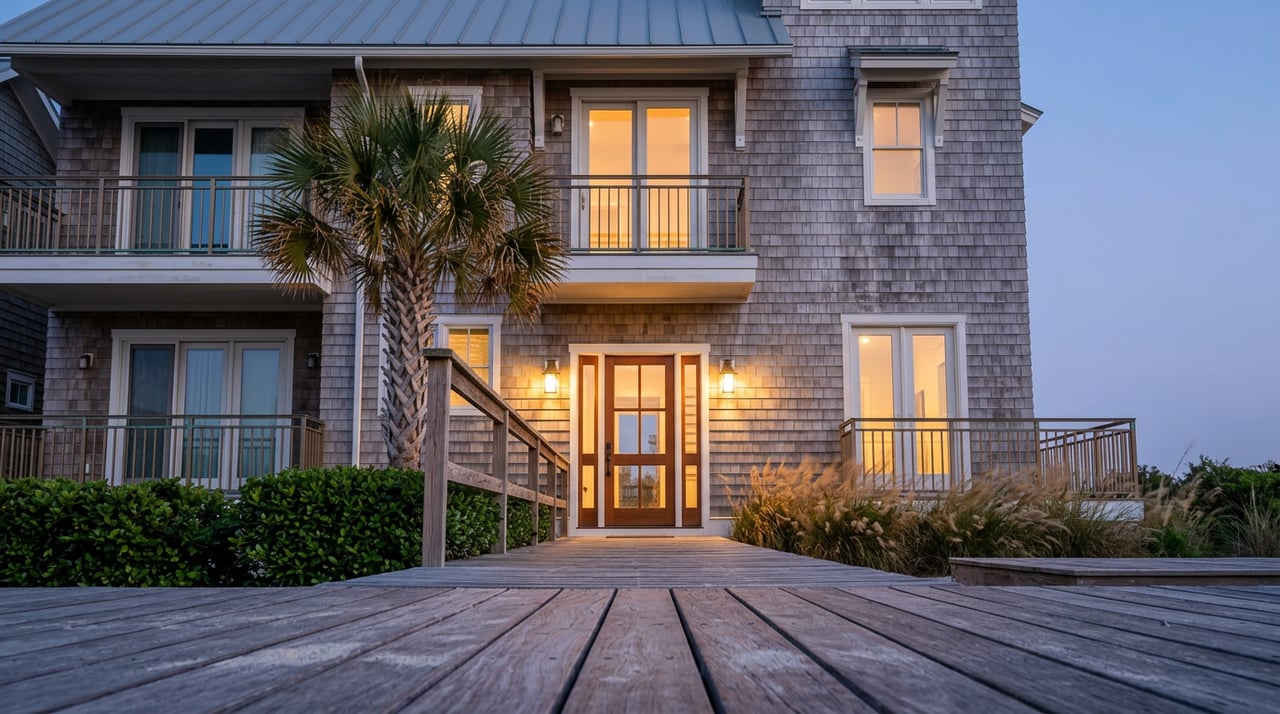
The building at 275 Waynick Boulevard operated as the Blockade Runner Beach Resort from 1964 until Castle Peak Holdings, which bought the property in 2022, announced in September 2024 that it would renovate and rebrand the hotel. The work finished in phases through early 2025, and the property reopened as Trailborn Surf & Sound, the outdoor hospitality brand's first beachfront location and fourth hotel overall. The new ownership kept the pool bar's old name, Blockade Surf Bar, as a nod to the property's history, but everything else, from the restaurant (now La Duna Paradiso) to the lobby, was rebuilt around the Trailborn identity.
That is a fast turnaround for a building that had operated under one name for six decades. It is also exactly the kind of change that outpaces habit. If you have lived on Wrightsville Beach long enough to remember checking in at the old front desk, "meet me at the Blockade Runner" is still a perfectly natural sentence to say out loud. The hotel has a new name, though some race materials still use the old one.
The race's course description for this year identifies the swim start at Trailborn Surf & Sound. The event schedule, on a different page of the same site, directs athletes to walk from Wynn Plaza to the "Blockade Runner Beach Start area." The schedule still uses the hotel's former name. If you're giving directions to a houseguest, a delivery driver, or your own kid on race morning, it helps to know that the old name refers to Trailborn.
What Actually Closes, and For How Long
Set the landmark confusion aside and the practical disruption is straightforward, though narrower than most people assume. Wrightsville Beach town officials have flagged seven streets for significant delays between 8:00 and 10:30 a.m. on race day: Causeway Drive, Old Causeway Drive, Dock Street, Seacrest Drive, Keel Street, Short Street, and Marina Street. Because the race uses staggered wave starts to send athletes into the water in groups rather than all at once, that 2.5-hour window isn't a single burst of activity around a start gun. It's a rolling closure that holds for the whole stretch.
The disruption doesn't stop at the island. The bike leg is an 11-mile single loop that crosses the Wrightsville Beach drawbridge onto the mainland and back, which in past years has meant lane closures on Eastwood Road and Wrightsville Avenue heading over the bridge, a closed lane on Airlie Road, and a full closure of Oleander Drive northbound between Greenville Loop Road and Airlie Road while cyclists work through that stretch. If your Saturday morning route to Mayfaire or Airlie Gardens runs through that corridor, the race reaches further into your commute than the name "Wrightsville Beach Triathlon" suggests.
The town's advice, echoed by race organizers, is to treat Highway 74, also signed as Salisbury Street, as the detour if you need to move through the area during the closure window, and to simply plan any beach trip for after 11:00 a.m. if you'd rather skip the disruption altogether. By late morning, transition breaks down, the roads reopen, and the loop and beach accesses go back to normal.
How the Race Has Grown
Part of why this event reaches as far as it does is that it has grown well past its original size. The race began in 1979 as the Pepsi Triathlon, the idea of Karl Sutter, a Wrightsville Beach resident and former college swimmer who read a small item in Sports Illustrated about the first Ironman triathlon, held the prior fall in Hawaii with 12 participants. Sutter brought the concept to the local YMCA, then led by Jack Morris, and the first Wrightsville Beach race drew 99 competitors that September. Nearly five decades later, it's recognized as one of the longest-running sprint triathlons on the East Coast, and this year's edition is sold out.
The event now includes four separate categories: the traditional Individual sprint, a Relay division, an Aquabike option for athletes skipping the run, and a Youth Triathlon for ages 7 to 15. In recent years that youth race has staged separately at Seapath Marina, starting after the last adult swimmer clears the water, with a shortened 100-meter swim, a roughly 4-mile bike leg, and a 1.6-mile run loop. None of that existed in the race's early decades. A single point-to-point swim and a bike loop have grown into a full morning of programming spread across separate start points, which is part of why the disruption now reaches beyond the beach itself.
The swim itself carries its own quirk worth knowing if you have a friend or neighbor racing. It's listed at 1,200 meters, unusually long for a sprint-distance event, but the course runs point to point with a consistent incoming tide, so the actual effort feels closer to 750 to 1,000 yards depending on how strong the current is running that morning. It's a detail that only makes sense once you understand the channel system between the island and Wilmington, which isn't an ocean swim at all despite the salt water.
If You're Not Racing
For residents sitting this one out, the morning comes down to a few practical choices. Transition sets up at Wrightsville Beach Park on Causeway Drive, so that immediate area and the walking route toward Trailborn Surf & Sound will be the most congested on foot and by car. If you need to be on the island during the closure window, build in the extra 30 minutes the town recommends, and lean on real-time navigation rather than the route you'd normally drive on autopilot. If you don't need to be there, 11:00 a.m. is the practical reset point when transition clears and the loop reopens.
For anyone sticking around to watch, the race's own post-event tradition is worth knowing: Lighthouse Beer and Wine opens for post-race beer at 9:00 a.m., right as the earlier waves start finishing. It's a small, specific detail, but it's the kind of thing that turns a morning of detours into an actual neighborhood event if you plan for it instead of around it.
None of this is really about a triathlon. It's about what it means to live somewhere that keeps quietly updating itself. The hotel at the center of race morning has a new name, a new restaurant, and a redesigned lobby, but the swim still runs the same channel it has for decades, and the race still finishes the way it did when Karl Sutter first brought the idea home from a magazine article in 1979. Knowing both halves, what's changed and what hasn't, is a better way to move through a Saturday here than either grumbling about the closures or assuming an old name means a different place.
If you're weighing a move to the island, or you already call it home and want a clearer read on how neighborhoods like this one actually function day to day, Sam Crittenden has spent decades tracking these details alongside the market itself. Schedule a private consultation to talk through what living on Wrightsville Beach really looks like, race mornings included.